Blazertje: Meaning, Style Guide, History & How to Wear It
If you have recently seen the word “Blazertje” online, in fashion content, or in discussions about European style, you may wonder what it means. At first glance, it looks like a new fashion brand or a special type of jacket. In reality, its story is closely connected to the Dutch language and the familiar blazer.
In simple terms, Blazertje is the Dutch diminutive form of blazer. It can be understood literally as “little blazer” or “small blazer.” Dutch uses diminutive endings such as “-je,” “-tje,” “-etje,” “-pje,” and “-kje” to create smaller, softer, more familiar, or affectionate forms of nouns. Dutch language references specifically list “blazertje” as the diminutive of “blazer.”
However, there is an important point that is often missed in online articles. Blazertje is not necessarily the name of one universally defined jacket design. In Dutch, it is first and foremost a grammatical diminutive. In English-language fashion content, however, the word is increasingly being used to describe a smaller, lighter, cropped, or more relaxed blazer.
That difference matters.
It helps explain why different websites describe a Blazertje in different ways. Some describe it as a lightweight blazer. Others use the word for a cropped blazer, a softer blazer, or a casual version of tailored outerwear. The most accurate approach is to understand both meanings: the original Dutch meaning and the newer fashion interpretation appearing in international online style discussions.
This guide explains the meaning of Blazertje, its Dutch language roots, how it relates to the traditional blazer, what features are commonly associated with the modern fashion interpretation, how to style it, how to choose the right one, and why this small change in tailoring can make such a big difference to an outfit.
What Does Blazertje Mean?
Blazertje is a Dutch word formed from “blazer” and the diminutive ending “-tje.”
The basic meaning is “little blazer.”
The Dutch word “blazer” refers to a blazer or jacket, while “blazertje” is its diminutive form. Dutch language references list “blazertje” as the singular diminutive and “blazertjes” as the plural form.
The word “little” should not always be understood as meaning that the garment must be physically tiny. This is an important part of understanding Dutch diminutives.
Dutch diminutives can communicate several ideas. They may indicate small size, but they can also make something sound more informal, friendly, familiar, soft, or affectionate. Dutch grammar resources explain that diminutives are not used only for objects that are physically small.
For example, a Dutch speaker can use a diminutive to create a softer or more familiar feeling around a noun. Therefore, Blazertje does not automatically mean a miniature jacket that would only fit a child.
In fashion writing, the word has taken on an additional layer of meaning. Many English-language articles now use Blazertje to describe a smaller, lighter, softer, cropped, or more casual interpretation of the blazer. That modern use is understandable, but it should not be confused with the original grammatical meaning.
The Dutch Language Roots of Blazertje
To understand Blazertje properly, it helps to look at how Dutch diminutives work.
Dutch has several diminutive endings. The choice depends on the ending, pronunciation, stress, and structure of the original word. Common endings include “-je,” “-tje,” “-etje,” “-pje,” and “-kje.”
The ending in Blazertje is “-tje.”
This changes:
Blazer → Blazertje
The result is not simply an English-style nickname. It follows a real Dutch word-formation pattern.
Dutch language sources identify Blazertje as the diminutive form of blazer. This gives us a stronger linguistic foundation than simply assuming that the word was invented by fashion bloggers.
This distinction is especially useful because many newer articles describe Blazertje as though it were a formally established international fashion category. The evidence supports a more careful conclusion.
The word itself is established in Dutch as a diminutive. Its use as a specific English-language fashion label for a cropped or lightweight blazer is a newer and more flexible development in online fashion writing.
Is Blazertje a Real Dutch Word?
Yes.
Blazertje is documented as the diminutive form of the Dutch noun blazer. Dutch lexical references list:
Blazer: blazer
Diminutive: blazertje
Plural of the diminutive: blazertjes.
This is important because some internet discussions treat Blazertje as an invented trend word. The word itself is not simply a recent internet invention. It has a legitimate place in Dutch word formation.
What is newer is the way international fashion websites have started using the term.
Online fashion articles increasingly describe a Blazertje as a lighter, softer, shorter, cropped, or casual blazer.
Also Read: InSnoop: The Anonymous Instagram Story Viewer
So there are really two connected meanings:
- The linguistic meaning: the Dutch diminutive of blazer.
- The modern fashion meaning: a relaxed, lightweight, compact, or cropped interpretation of the blazer.
Keeping these meanings separate makes the subject much easier to understand.
Blazertje vs. a Traditional Blazer
The easiest way to understand the fashion interpretation of Blazertje is to compare it with a traditional blazer.
A traditional blazer is usually associated with tailored clothing. Depending on its design, it may have a defined shoulder line, structured lapels, a lining, a more substantial fabric, and a relatively formal silhouette.
A Blazertje, in modern fashion usage, generally moves in the opposite direction.
It may be:
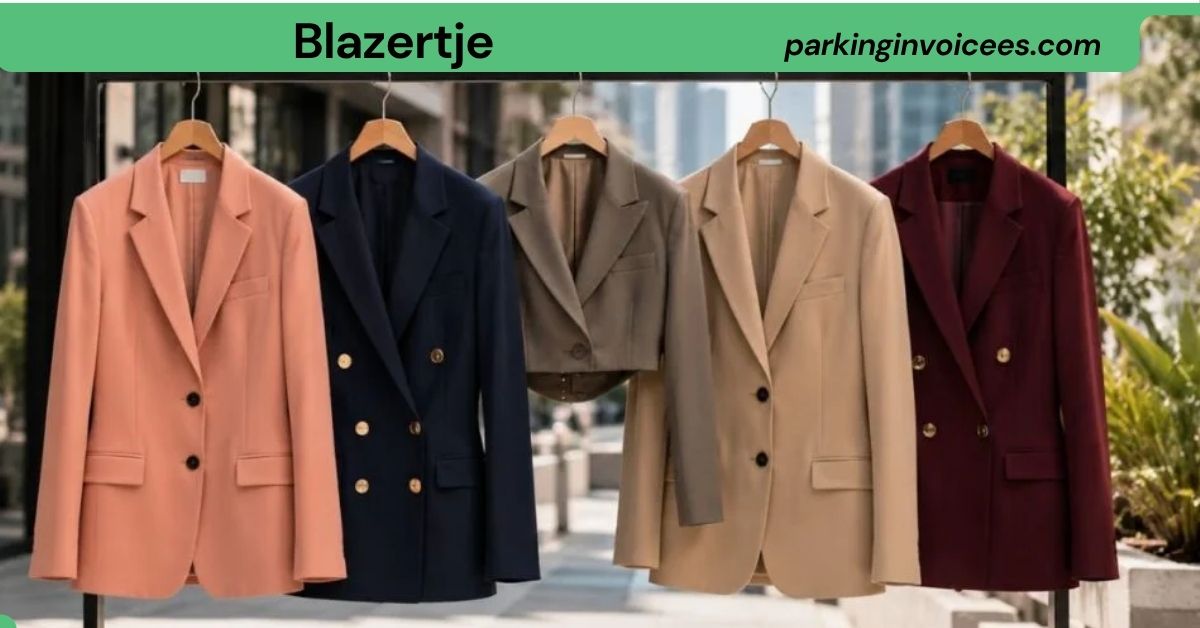
- Shorter
- Lighter
- Less structured
- More relaxed
- Easier to layer
- More casual
- More suitable for everyday outfits
- Designed with softer fabrics
- Cropped around the waist or upper hip
But none of these features is an absolute rule.
This is one of the most important insights for shoppers. You should not reject a jacket simply because it is not extremely cropped or because it has some structure. The word is flexible.
Think of Blazertje as a style idea rather than a rigid technical specification.
The central idea is the combination of blazer-like polish with greater ease.
What Does a Modern Blazertje Look Like?
There is no single universal design, but several features appear repeatedly in modern descriptions of the term.
A typical fashion-oriented Blazertje may have the recognizable elements of a blazer:
- Lapels
- Buttons
- Long sleeves
- Front pockets
- A tailored front
- A defined waist or shoulder
- A jacket-style construction
What changes is the feeling of the garment.
Instead of looking like a strict business jacket, it may feel lighter and more relaxed.
Some versions are cropped. Others end around the upper hip. Some have a boxy shape, while others are fitted.
Some are lined, while others are unlined.
Some are made from traditional tailoring fabrics, while others use cotton, linen, jersey, knit blends, ponte, or stretch materials.
This variety is actually one of the reasons the concept works so well for modern wardrobes.
The Difference Between a Blazertje and a Cropped Blazer
These terms are related, but they are not identical.
A cropped blazer is a blazer that has been intentionally cut shorter than a conventional blazer. It can be made in many different styles.
A Blazertje, in its original Dutch sense, simply means the diminutive of blazer.
In modern online fashion language, however, Blazertje is often used for a cropped or compact blazer.
That means the two terms can overlap, but they should not be treated as exact synonyms.
A cropped blazer can be highly structured and formal.
A Blazertje can be lightweight, soft, casual, or traditionally tailored.
The important difference is that “cropped” describes length, while “Blazertje” can describe the word’s linguistic form and, in fashion contexts, a broader styling concept.
Blazertje and the Evolution of the Blazer
The modern appeal of the Blazertje makes more sense when we look at how the blazer itself evolved.
The blazer has a long history connected to British sporting, club, and naval clothing. Over time, it moved beyond those settings and became part of everyday tailoring.
Eventually, the blazer became a major part of professional clothing.
For many years, wearing a blazer usually meant dressing up. It was associated with offices, meetings, formal dinners, business events, and other situations where a polished appearance was expected.
Modern clothing culture has changed that relationship.
People now mix formal and casual pieces much more freely.
A blazer can be worn with jeans.
A tailored jacket can be worn with sneakers.
A jacket once reserved for the office can be worn over a simple T-shirt.
This shift created a strong demand for softer tailoring.
The Blazertje fits naturally into this development.
Rather than removing the visual structure of the blazer, it reduces some of its formality.
That is why the concept feels modern.
Why the Blazertje Has Become Interesting in Modern Fashion
The appeal of the Blazertje is not only about appearance.
It is also about how people live.
Many people want clothes that can perform several jobs.
They may leave home in the morning for work, meet friends in the afternoon, travel across town, and attend dinner in the evening.
Changing into completely different clothing for every activity is not always practical.
A softer blazer can solve part of this problem.
Wear it with trousers and a button-down shirt, and the outfit can look professional.
Wear the same jacket with jeans and a T-shirt, and it can feel relaxed.
Put it over a dress, and it can add structure.
Layer it over a knit top, and it becomes useful during cooler weather.
This versatility is one of the strongest reasons the Blazertje concept works.
Also Read: Foenegriek: Benefits, Uses, Nutrition, Safety, and What Science Says
The Blazertje and Smart-Casual Dressing
Smart-casual clothing can be difficult to define.
It sits between formal businesswear and everyday casual clothing.
A T-shirt and jeans may be too relaxed for some settings.
A full suit may be far too formal.
The Blazertje offers a middle ground.
The jacket gives the outfit a clear shape, while a softer fabric or shorter cut keeps the look from becoming too serious.
For example, a neutral Blazertje with dark jeans and a clean T-shirt can create a polished everyday outfit.
For work, the same jacket can be worn with tailored trousers and a simple shirt.
The key is balance.
If the jacket is highly structured, keep the rest of the outfit simple.
If the jacket is very casual, pair it with cleaner trousers or polished shoes.
Choosing the Right Fabric for a Blazertje
Fabric has a major effect on how a Blazertje looks and feels.
Different fabrics create different levels of formality.
Cotton
Cotton is a practical option for casual wear.
It can feel comfortable and breathable, especially when the jacket is designed without heavy construction.
Cotton Blazertjes work well with jeans, chinos, skirts, casual dresses, and simple shirts.
Linen
Linen is useful for warm weather.
It is light and breathable, which makes it attractive for summer outfits.
The main drawback is wrinkling.
That is not necessarily a problem. Linen’s relaxed appearance can actually support the casual character of a Blazertje.
Wool
Lightweight wool can give a Blazertje a more refined appearance.
Fine wool can work well for office clothing and cooler weather.
A lightweight wool jacket may also hold its shape better than very soft casual fabrics.
Jersey and Knit Fabrics
Stretch fabrics can make a blazer much more comfortable.
Jersey and knit materials allow easier movement and can feel less restrictive than traditional tailoring.
They are especially useful for travel or long days.
Blended Fabrics
Fabric blends can combine useful qualities.
For example, a blend may offer stretch, durability, wrinkle resistance, or easier care.
For everyday use, fabric performance can be more important than simply choosing the most luxurious material.
How to Choose the Right Blazertje Fit
Fit is more important than the label.
A beautiful Blazertje will not look polished if the shoulders, sleeves, chest, or waist fit poorly.
Start with the shoulders.
The shoulder seam should generally sit close to the natural shoulder unless the design is intentionally oversized.
Next, check the chest.
You should be able to move your arms without excessive pulling across the front.
Then check the sleeves.
Sleeves that are extremely long can make a cropped jacket look awkward. Sleeves that are too short can make the jacket look undersized unless the design intentionally calls for a shorter sleeve.
Finally, examine the jacket length.
This is especially important with a Blazertje because shorter jackets can dramatically change body proportions.
How Jacket Length Changes Your Outfit
A shorter jacket can visually make the legs appear longer because it moves the visual waistline upward.
This can work especially well with high-rise trousers, jeans, or skirts.
A waist-length Blazertje can create a strong, defined silhouette.
An upper-hip Blazertje can provide a softer appearance.
A slightly longer version can feel closer to a conventional blazer.
There is no single best length.
The right choice depends on your clothing, proportions, comfort, and the overall look you want.
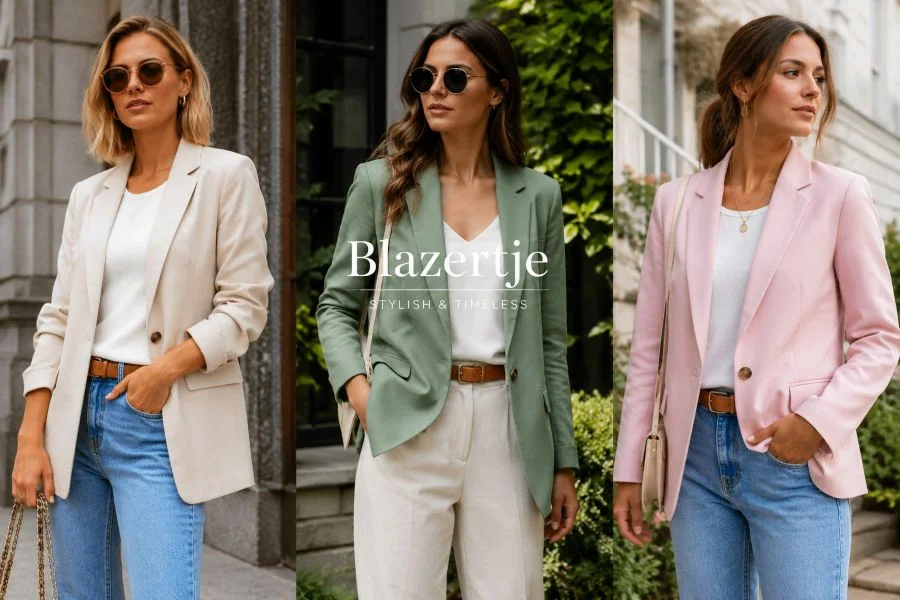
How to Wear a Blazertje With Jeans
One of the easiest combinations is a Blazertje and jeans.
For a clean everyday outfit, try:
Blazertje + white or neutral T-shirt + straight-leg jeans + loafers or clean sneakers.
This combination works because each item has a different role.
The T-shirt keeps the outfit relaxed.
The jeans provide a casual foundation.
The Blazertje adds structure.
The shoes determine the final mood.
Sneakers make the look more casual.
Loafers make it more polished.
Ankle boots can give the outfit a stronger autumn or winter feel.
How to Wear a Blazertje With Trousers
For a more refined look, combine a Blazertje with tailored trousers.
Matching colors can create a modern suit-like appearance without the stiffness of a traditional suit.
For example, a neutral jacket with matching trousers can look clean and professional.
Alternatively, use contrasting colors.
A dark Blazertje with light trousers creates a clear visual separation.
The most important rule is proportion.
If the jacket is very cropped, high-waisted trousers often create a balanced silhouette.
How to Wear a Blazertje With a Dress
A Blazertje can also work beautifully over a dress.
This is useful when a dress feels too soft or lacks structure.
A fitted or cropped jacket can define the upper body.
A looser jacket can create a more relaxed layered appearance.
For formal events, choose a cleaner fabric and refined accessories.
For casual occasions, a lightweight jacket with a simple cotton or knit dress can feel effortless.
How to Wear a Blazertje in Summer
Summer is one of the strongest seasons for lightweight tailoring.
Choose breathable fabrics such as linen, lightweight cotton, or suitable blends.
Light colors can also create a seasonal appearance.
Cream, beige, light gray, soft blue, and other muted colors can work well for daytime outfits.
Avoid heavy layers underneath.
A simple tank top, T-shirt, lightweight shirt, or sleeveless dress can be enough.
The goal is to keep the outfit visually polished without creating unnecessary heat.
How to Wear a Blazertje in Fall
Fall offers more opportunities for layering.
Try a Blazertje over:
- A lightweight sweater
- A button-down shirt
- A turtleneck
- A long-sleeve T-shirt
- A thin knit top
Dark neutrals work especially well during fall.
Brown, charcoal, navy, olive, cream, and black can be combined in many ways.
A Blazertje can also work beneath a larger coat when temperatures become colder.
How to Wear a Blazertje in Winter
A lightweight Blazertje is not a replacement for a winter coat.
Instead, think of it as an indoor or intermediate layer.
Wear it under a wool coat, insulated coat, or other cold-weather outerwear.
Choose a fabric with enough room to allow another layer underneath.
If the Blazertje is extremely fitted, layering a thick sweater beneath it may be uncomfortable.
For winter, slightly relaxed tailoring can therefore be more practical.
Blazertje Styling for Men
The Blazertje is not limited to women’s fashion.
A relaxed blazer can be a useful part of a men’s wardrobe as well.
Try a lightweight jacket with:
- Dark jeans
- Chinos
- Pleated trousers
- Oxford shirts
- Polo shirts
- Plain T-shirts
- Loafers
- Minimal sneakers
The key is to avoid making every item equally formal.
For example, a structured jacket, dress shirt, tie, polished trousers, and formal shoes create a very formal outfit.
Replace the tie with a T-shirt and the formal trousers with dark denim, and the same jacket can become much more relaxed.
Blazertje Styling for Women
Women can use the Blazertje in many ways because its shorter shape works well with different silhouettes.
Try it with:
- High-waisted jeans
- Wide-leg trousers
- Straight trousers
- Midi skirts
- Mini skirts
- Dresses
- Tailored shorts
- Jumpsuits
A cropped jacket can emphasize the waist.
A boxy jacket can create a relaxed silhouette.
A fitted jacket can create a more traditional tailored appearance.
The best choice depends on personal style rather than a strict fashion rule.
Can Anyone Wear a Blazertje?
Yes.
There is no body type that owns the Blazertje.
The important issue is choosing a shape that supports the proportions you prefer.
If you want to emphasize your waist, choose a more fitted or shorter design.
If you prefer a relaxed silhouette, choose a boxier cut.
If you want more shoulder definition, look for a jacket with gentle structure.
If you want maximum comfort, choose softer fabrics and less restrictive construction.
Fashion works best when clothing supports the wearer instead of forcing the wearer into a particular shape.
Blazertje for Petite Frames
A shorter blazer can work particularly well for petite wearers because it can help create the appearance of longer legs.
However, too much oversized fabric can sometimes overwhelm a smaller frame.
A cropped jacket with a clean shoulder line can therefore be a useful option.
Also Read: Nerwey: The Online Publishing Name, Its Meaning, Uses, and Digital Presence
High-rise trousers or skirts can further strengthen the effect.
The important point is not to follow a rigid rule but to test different proportions.
Blazertje for Tall Frames
Tall wearers can often handle longer or more oversized versions easily.
However, a cropped Blazertje can also create an interesting proportion by visually breaking up a longer silhouette.
Wide-leg trousers with a shorter jacket can create a strong fashion-forward shape.
The combination works because the jacket creates a clear upper-body boundary while the trousers provide length.
How to Choose a Blazertje for Work
Before wearing a Blazertje to work, consider your workplace dress code.
A very cropped or highly decorative jacket may not be suitable for a conservative office.
For professional environments, choose:
- Moderate length
- Clean tailoring
- Neutral colors
- Simple buttons
- Minimal decoration
- Good fabric quality
- Comfortable but controlled fit
For creative workplaces, you can experiment more with color, texture, oversized proportions, or unusual details.
The safest approach is to match the jacket’s formality to the environment.
Can a Blazertje Be Worn to an Interview?
Potentially, yes, but context matters.
For a conservative interview, a traditional blazer or suit jacket may be the safer option.
For a creative, modern, or casual workplace, a refined Blazertje may work.
The key is to avoid making fashion experimentation more important than professionalism.
If you are uncertain about the company’s dress code, research its culture and choose the more conservative option.
A job interview is one situation where versatility should not become an excuse for underdressing.
Blazertje for Travel
A lightweight blazer can be extremely useful for travel.
It can make a simple outfit look more polished without requiring a complete wardrobe change.
It can also provide an extra layer in airports, airplanes, restaurants, and cool indoor spaces.
For travel, look for fabrics that resist wrinkles and designs that are comfortable while sitting.
Stretch can be useful.
Deep pockets can also be practical.
A jacket that looks attractive but restricts movement may become frustrating during a long journey.
Blazertje as a Capsule Wardrobe Piece
The Blazertje can fit naturally into a capsule wardrobe.
A capsule wardrobe focuses on a smaller number of versatile pieces that work together.
A neutral Blazertje can connect different outfits.
For example, one jacket can work with:
- Blue jeans
- Black trousers
- Beige trousers
- A simple dress
- A white shirt
- A knit top
This reduces the need to own many separate jackets.
A useful buying principle is to ask how many existing outfits the jacket can complete.
If the answer is one, it may be a special-occasion purchase.
If the answer is ten or twenty, it may become a wardrobe foundation.
Choosing the Best Color for a Blazertje
Color should match your existing wardrobe.
Black is highly versatile and creates a strong appearance.
Navy can feel softer and works well with denim.
Beige and cream are useful for light, minimalist outfits.
Gray works across many seasons.
Brown can create a warm, modern look.
Bold colors can be excellent when the rest of your wardrobe is neutral.
There is no universally best color.
The best color is the one you will actually wear.
Should You Buy a Black Blazertje?
A black Blazertje is often a strong first choice.
It can work with jeans, trousers, dresses, skirts, and monochrome outfits.
However, black is not automatically the best choice for everyone.
If your wardrobe is already full of black clothing, navy, gray, brown, cream, or olive may give you more variety.
The smartest purchase is usually the jacket that fills a real gap in your wardrobe.
Accessories That Work With a Blazertje
Accessories can completely change the impression of a Blazertje.
For a minimalist look, use simple jewelry, a clean watch, or a structured handbag.
For a casual outfit, sneakers and a simple crossbody bag can lower the formality.
For an evening outfit, refined shoes and jewelry can make the same jacket feel more sophisticated.
Belts can be especially useful when wearing a cropped jacket with high-rise trousers.
The important principle is coordination rather than excess.
Common Blazertje Styling Mistakes
Even a versatile jacket can be difficult to style if the proportions are wrong.
One common mistake is combining a very cropped jacket with low-rise trousers when the intended look depends on a clear waistline.
Another mistake is choosing a jacket that is too small.
Tailored clothing should look intentional, not restrictive.
Another problem is excessive formality.
If you want a casual outfit, combining the Blazertje with formal trousers, dress shoes, and a formal shirt may defeat the purpose.
Balance is the answer.
Mix one structured element with softer or more casual pieces.
How to Care for a Blazertje
Care depends on the fabric and construction.
Always check the garment’s care label first.
Some jackets can be machine washed.
Others require dry cleaning.
Some lightweight fabrics benefit from gentle steaming rather than ironing.
Do not assume that every blazer should be dry-cleaned after every wear.
Frequent unnecessary cleaning can place additional stress on fabric.
For light everyday use, airing the jacket and removing minor wrinkles with an appropriate steamer may be enough, depending on the care instructions.
Proper storage also matters.
Use a suitable hanger that supports the shoulders.
Avoid crushing the jacket under heavy clothing.
Good care can significantly extend the useful life of a garment.
Is a Blazertje Sustainable Fashion?
The word Blazertje itself does not automatically mean sustainable fashion.
Sustainability depends on how a garment is designed, produced, purchased, used, maintained, and eventually discarded.
A high-quality jacket that remains in your wardrobe for years can be a more responsible purchase than a poorly made jacket that quickly loses its shape and is replaced.
When shopping, consider:
- Fabric durability
- Construction quality
- Repairability
- Expected frequency of use
- Care requirements
- Brand transparency
- Secondhand options
- Whether you genuinely need the garment
The most sustainable jacket is often the one that you will actually wear many times.
New or Secondhand Blazertje?
Both options have advantages.
A new jacket gives you access to current sizes, fabrics, and designs.
A secondhand jacket can provide quality construction at a lower price and extend the life of an existing garment.
Vintage stores can also offer unusual cuts and fabrics that are difficult to find in current collections.
When buying secondhand, inspect:
- Collar condition
- Underarm areas
- Sleeve seams
- Buttons
- Lining
- Pockets
- Shoulder structure
- Stains
- Odor
- Fabric wear
A small repair may be worthwhile if the underlying construction is strong.
How to Tell if a Blazertje Is Well Made
Price alone does not determine quality.
Look closely at the stitching.
The seams should appear reasonably even.
Buttons should be securely attached.
The fabric should recover well after movement.
The collar should sit naturally.
The jacket should maintain its shape without feeling excessively stiff.
Inside the garment, examine the lining and seam finishing.
A jacket does not need expensive construction to be useful, but quality details can improve comfort and lifespan.
Is Blazertje a Fashion Trend or a Timeless Piece?
The answer depends on which part you mean.
The word Blazertje is not new in Dutch language structure.
The fashion trend of describing a shorter, softer, or more casual blazer as a Blazertje is much newer in international online fashion discussions.
The broader idea, however, is unlikely to disappear.
Why?
Because the blazer itself is highly adaptable.
Whenever fashion moves toward more casual clothing, the blazer can become softer.
Whenever fashion moves back toward tailoring, the blazer can become more structured.
The Blazertje sits comfortably between these two directions.
That makes it less dependent on a single seasonal trend.
What Makes the Blazertje Different From a Suit Jacket?
A suit jacket is normally designed as part of a matching suit.
Its fabric, color, and construction are intended to coordinate with matching trousers.
A blazer is more independent.
It is designed to work with different trousers, jeans, skirts, or dresses.
A Blazertje, especially in modern casual usage, pushes that independence even further.
It is often intended to be a flexible standalone piece.
This distinction is useful when shopping.
If you want one jacket that works with many different bottoms, look for blazer-like versatility rather than a strict suit jacket.
Blazertje vs. Cardigan
A cardigan is usually softer and more knitted.
It provides comfort but does not necessarily create the same structured silhouette.
A Blazertje offers more visual definition.
This makes it useful when you want to look polished without wearing a full suit.
The choice depends on the desired effect.
Choose a cardigan for softness and warmth.
Choose a Blazertje for structure with relatively relaxed styling.
Blazertje vs. Bomber Jacket
A bomber jacket has a very different construction.
It commonly features a shorter body, ribbed edges, and a sporty appearance.
A Blazertje retains blazer details such as lapels and tailored lines.
The Blazertje therefore occupies a middle space between casual and formal dressing.
A bomber is generally more sporty.
A Blazertje is generally more polished.
Blazertje vs. Bolero
A bolero is usually much shorter and can have a distinctive formal or decorative character.
A Blazertje generally retains more of the standard blazer structure.
The two can look similar when both are cropped, but their design histories and typical uses are different.
This is another reason not to treat every short jacket as a Blazertje.
Why the Term Can Be Confusing Online
Search results about Blazertje currently show different descriptions.
Some sources call it a little blazer.
Others describe it as a lightweight blazer.
Others define it as a cropped blazer.
This variation exists because the original Dutch meaning is broader than the newer English fashion interpretation.
Some online articles also make strong claims that the Blazertje is a formally recognized global fashion category. Those claims should be treated cautiously.
The strongest evidence is linguistic: Blazertje is a Dutch diminutive of blazer.
The fashion interpretation is best understood as an emerging descriptive usage rather than a strict technical garment standard.
That distinction gives readers a more accurate understanding.
The Blazertje and Modern Personal Style
The biggest lesson behind the Blazertje is not actually about one jacket.
It is about flexibility.
Modern wardrobes increasingly mix categories.
Formal clothing can become casual.
Casual clothing can become polished.
Traditional tailoring can be combined with streetwear.
A jacket no longer needs to belong to only one social setting.
The Blazertje represents this change particularly well because it retains enough structure to look intentional while offering enough flexibility for everyday life.
That is why it can appeal to people who normally dislike traditional blazers.
How to Build an Outfit Around a Blazertje
Start with the jacket.
Then choose one strong supporting piece.
For example:
Blazertje + jeans
Blazertje + wide-leg trousers
Blazertje + simple dress
Blazertje + skirt
After choosing the main combination, keep the remaining pieces relatively simple.
This prevents the outfit from becoming visually crowded.
Next, choose shoes based on the occasion.
Finally, add accessories.
This approach makes styling easier because you are building from the strongest element outward.
A Simple Blazertje Shopping Checklist
Before buying, ask yourself several questions.
Does the jacket fit comfortably across the shoulders?
Can you move your arms freely?
Does the length work with your trousers or skirts?
Is the fabric appropriate for your climate?
Can you wear it with at least five outfits?
Does the color fit your existing wardrobe?
Can you care for it easily?
Is the construction strong enough for the price?
Will you still want to wear it next year?
These questions are often more useful than simply asking whether the jacket is currently fashionable.
Who Should Consider Buying a Blazertje?
A Blazertje can be useful for people who:
- Want a softer alternative to formal tailoring
- Need smart-casual clothing
- Travel frequently
- Prefer versatile wardrobes
- Like cropped silhouettes
- Want to dress up jeans
- Need an easy office layer
- Enjoy mixing formal and casual clothing
- Want one jacket that works across several settings
But nobody needs to buy one simply because it is trending.
If you already own a blazer that performs the same role, another jacket may not add much value.
Good fashion is not about buying every new term.
Also Read: BadSeed Tech Carpio: Complete Guide to the Carpio 2.0 BadSeed Tech Edition
It is about understanding what a garment can contribute to your actual life.
Frequently Asked Questions About Blazertje
Is Blazertje an English word?
Blazertje comes from Dutch. It is the diminutive form of blazer, and Dutch lexical references list it as the diminutive of blazer.
In English-language fashion content, the term is increasingly being used as a style label for a smaller, lighter, cropped, or more relaxed blazer.
What is the literal translation of Blazertje?
The simplest translation is “little blazer.”
The “-tje” ending is a Dutch diminutive ending.
Does Blazertje always mean a cropped blazer?
No.
This is one of the most important distinctions.
In Dutch, Blazertje is grammatically the diminutive form of blazer. In international fashion content, it is often used to describe a cropped or compact blazer, but there is no universal rule that says every Blazertje must end at the waist.
Is Blazertje a brand?
Not necessarily.
The word itself is a Dutch noun form. A business may use Blazertje as a brand or website name, but the word does not automatically refer to one company or product.
Is Blazertje only for women?
No.
The concept can be used in men’s, women’s, and gender-neutral fashion. A blazer’s cut, fabric, color, and styling determine its appearance more than the word itself.
Can a Blazertje be oversized?
Yes.
A shorter jacket can still have an oversized or relaxed shape.
Length and volume are separate design features.
Can a Blazertje be formal?
Yes, depending on its construction.
A cropped or lightweight jacket does not automatically make an outfit casual.
A refined fabric, clean tailoring, neutral color, and polished styling can create a more formal appearance.
Is a Blazertje the same as a mini blazer?
Sometimes the terms overlap.
“Mini blazer” is an English descriptive term.
“Blazertje” is a Dutch diminutive and, in modern fashion content, is sometimes used in a similar way.
However, they are not exact linguistic equivalents in every context.
What should I wear under a Blazertje?
Simple pieces usually work best.
Try a T-shirt, button-down shirt, tank top, thin knit, or lightweight blouse.
The right choice depends on the season and how formal you want the outfit to look.
Can I wear a Blazertje with sneakers?
Yes.
Sneakers are one of the easiest ways to make a blazer-style jacket feel more casual.
Clean, simple sneakers usually create a more polished result than heavily athletic footwear.
Is a Blazertje good for summer?
A lightweight version can be excellent for summer.
Look for breathable fabrics such as linen or lightweight cotton and avoid unnecessary layers.
How should a Blazertje fit?
The correct fit depends on the intended design.
A fitted Blazertje should not pull across the chest or shoulders.
An oversized Blazertje should look intentionally relaxed rather than simply too large.
Is a Blazertje good for a capsule wardrobe?
Yes.
A neutral, versatile Blazertje can work with jeans, trousers, skirts, and dresses, making it useful in a smaller wardrobe.
Can men wear a cropped Blazertje?
Yes.
Cropped and shorter tailoring can be styled in men’s fashion as well. The important factors are proportion, confidence, and the overall outfit.
Does “Blazertje” mean a child’s blazer?
Not automatically.
The diminutive ending does not mean the garment must be designed for children. Dutch diminutives can express smallness, familiarity, informality, or other nuances.
How do you pronounce Blazertje?
For English speakers, the pronunciation can be difficult because Dutch sounds do not map perfectly to English pronunciation.
A practical approximation is something close to “blah-zer-tyuh,” although the exact Dutch pronunciation is different.
Is Blazertje a new fashion trend?
The word itself is not simply new. It is a Dutch diminutive of blazer.
What is newer is its appearance in international online fashion discussions as a descriptive term for smaller, lighter, softer, or cropped blazer styles.
Should I buy a Blazertje or a traditional blazer?
Choose based on your lifestyle.
A traditional blazer is better when you need conventional professional tailoring.
A Blazertje may be more useful when you want casual versatility, lighter construction, or a shorter silhouette.
Many wardrobes can benefit from having both.
Final Thoughts on Blazertje
Blazertje is a fascinating example of how language and fashion can meet.
At its linguistic core, Blazertje is a Dutch diminutive of blazer. The “-tje” ending creates a smaller or more familiar form, and Dutch language references explicitly identify blazertje as the diminutive of blazer.
In modern international fashion writing, the word has developed a broader association with lighter, shorter, softer, or more casual blazer styles. That interpretation reflects the direction of contemporary tailoring, but it should not be treated as a strict dictionary definition.
This distinction is what makes the term interesting.
The Blazertje is not valuable simply because it has a fashionable name. Its real appeal comes from what the garment represents: a move toward clothing that is polished without being uncomfortable, structured without being rigid, and stylish without being difficult to wear.
For many people, that makes a Blazertje a practical wardrobe choice.
The best version is not necessarily the shortest, trendiest, or most expensive one. It is the jacket that fits well, works with your existing clothes, suits your lifestyle, and remains useful after the current fashion cycle has passed.
That is ultimately why the idea of the Blazertje has such lasting potential. It takes the familiar blazer and makes the concept feel easier, lighter, and more adaptable for everyday life.
For anyone searching for a modern alternative to traditional tailoring, understanding Blazertje is therefore less about following a trend and more about understanding the changing relationship between formal clothing and everyday style.